Caring at the speed of life
Should a wetland facing extinction wait for another annual funding cycle? How can we naturalise money into microflows towards creating conditions for regenerating life in our bioregions (places)?
We're testing whether and how money can become a native ecosystem participant—flowing toward life rather than against it.
Obuntu Resets' premise is that the climate crisis is not about carbon, rather it is a symptom of broken relations:
Between humans and nature
Between communities and their ecosystems
Between our economic system and the living world
The regenerative imperative is not to capture more carbon, rather to restore/heal these broken relations—one at a time. And as a measure of the aliveness or health of how one relates to other life in a place, Obuntu offers a pathway to systemic regeneration.
Can "interested" —individuals and organisational funders seeking meaning, not compliance—catalyse healing relations at the speed communities of life in a place actually need?
Your participation generates evidence for a different relationship between money and life.
Version 1: Community-led collective decision-making—where landstewards use quadratic voting (1 decimal of land = 1 vote) to prioritise and budget relations to heal.
Version 2: Relational accounting—making visible how healing one relation cascades into others. When waste transforms, water, soils heal. When governance heals, trust, wellbeing grow. When elders speak, youth find purpose.
Version 3: Bioregional scaling—100+ places worldwide experimenting with money as kin.
Each version builds on what we learn together. Your engagement shapes what comes next.
Be part of creating a new pattern—where money becomes kin, a native participant in the ecosystem of life rather than an invasive force against it.
BIOREGION
From fragmented plots to collective stewardship—Nalubaaga bioregion's journey toward regeneration
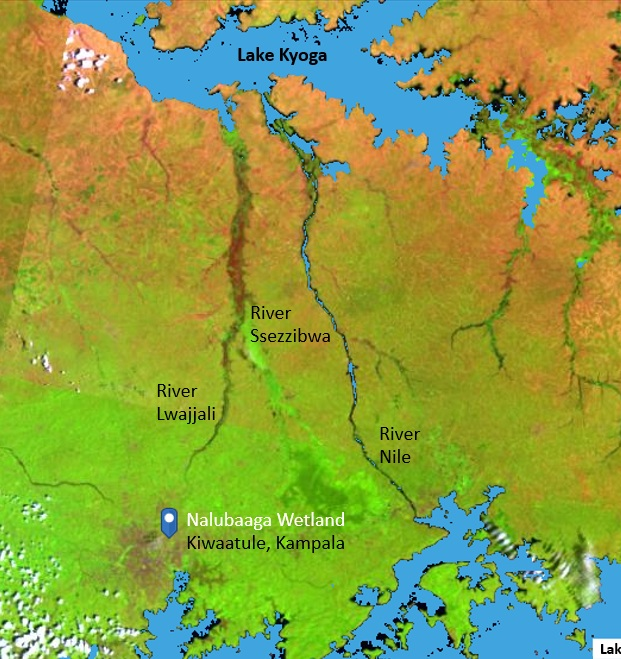
On the edges of Kampala, 800+ landowners across 500+ acres are pioneering a new relationship with land. Today urban sprawl is fragmenting community and degrading Nalubaaga wetland, but for 24 months, a collective awakening has been emerging. 92% of engaged landowners have expressed willingness to transition from "my plot" to "our place"—co-stewarded through Obutaka, where 1 decimal of land = 1 relational vote = 1 share.
In her rural days, Nalubaaga wetland once hosted thriving biodiversity—fish, primates, bird life, medicinal plants, springs, forest—this gave her the name 'Plentiful Bioregion'. This memory offers a blueprint for restoring the degenerating mutualism between human settlement and nature in an urban context.
Building community capacity for collective decision-making, bioregional consciousness, and place stewardship. The wetland participates in decisions as a stakeholder. Future generations have voice through a Futures Council.
With the headwaters of Nalubaaga wetland, Kiwaatule, the Obuntu Living Drum—is called to drum rhythms of biocultural renewal, creating post-colonial trends for urban development—a living lab offering the world a blueprint for community-led, state-enabled place stewardship grounded in Obuntu.
We are executing progressive acts of collaboration—from neighborhood dialogues to land recommoning ceremonies—that rebuild trust in collective governance while restoring ecological, cultural, and economic health. This Obuntu Resets platform will enable landowners access resources while practicing place stewardship.
Click each section to learn more
Because the polycrisis we face is fundamentally a crisis of relation, we must reset how we relate with the tool that coordinates our collective action: 'money'.
Culture of Money Today
"I'm modern money. I coordinate humans to bend nature to their will. I'm an invasive species—well, object—where I grow (and I grow limitlessly), life dies."
Culture of Money Tomorrow
"I'm new (ancient) money. I'm in kinship with life—a native ecosystem participant. I coordinate humans to align their will with the nature of being human—enriching all life in a place."
Obuntu Resets' premise is that the climate crisis is not only about carbon, but of broken relations—between humans and nature, between communities and their ecosystems, and between our economic system and the living world. The regenerative imperative is not to capture more carbon, rather to restore/heal these broken relations—one at a time.
"Can someone please separate out the carbon, biodiversity, water, air, habitat, aesthetic, spiritual, & cultural values of a wetland for me? And then sell them to me one at a time without selling me the others? And without selling me the underlying natural asset?" — Thomas Morgan on LinkedIn
Unlike carbon credits, which are units of offsetting carbon emissions, Obuntu Resets are Units of Caring—resetting the flow of catalytic funding towards restoring the broken human-nature relations in place. As a 'measure' of the quality of relations 'with' and 'within' a place, Obuntu offers a pathway to systemic regeneration.
1 Unit of Caring = $7.07 USD of relational healing
Emerging from community assessment
Grounded in specific bioregions
They are not carbon offsets that allow harm to continue elsewhere. They are not charity that creates dependency. They are not investment seeking financial returns. They are not solutions imposed by external experts.
Instead, they are invitations to fuel what communities have already determined is essential for life to thrive—shifting from "Problem → Money → Action" to "Imaging Right Relation → Money → Action → Enriched Relation."
Toward healing specific relations, sensed, mapped, shared intent, budgeted and issued by communities in place:
Each reset activates Obutaka—the land-sourced belonging, authority, and calling to care for all life. When one relation heals, others cascade: cleaner water, air, richer soils, better nutrition, youth purpose, renewed hope.
Not toward reductionist "impact metrics" designed by distant funders. Not toward surface symptoms that leave root causes untouched. Not toward projects that extract value from place rather than enriching it. Not toward compliance requirements that force communities to perform for external validation.
The community—with their natural ecosystems like wetland, river, forest and future generations as stakeholders—decides priorities.
"After 24 months of deep listening, Kiwaatule's essence emerged as the Obuntu Living Drum—awakening us to a fundamental truth: We cannot evolve our relation with life on earth without evolving our relation with land, and we cannot evolve our relation with land without evolving our relation with money, and evolution cannot happen without learning by doing."
This initiative emerges from the Nalubaaga wetland bioregion in Kampala, Uganda—where 92% of 300+ landowners have expressed willingness to collectively govern 500+ acres. The language is shifting from "my plot" to "our place." Through $30,000 of micro-caring flows, 13 core relations are moving from broken/absent to emerging.
The current financial infrastructure is not designed for this shift—it would rather continue funding symptoms of systemic failure, perpetuating the status quo. Further, it's not built for learning and evolution, at least toward living systems. This requires aligned individuals and organizations like you to lead.
Together we can demonstrate a healthier relation with money that flows with, rather than against, the forces of nature.
Nascent movements are already questioning the dominant narrative on financial flows. Many small initiatives are achieving outsized impact—thousands of acres of land bought and returned to indigenous peoples, funding commons-based regenerative economies, etc. But these remain in closed circles.
The same way mycelial networks transform and transport decomposing nutrients to nourish forests, soils, and climate, now is the time to create a mycelial network for money to flow towards nourishing life in the places/bioregions we call home.
The degrading wetland, soil, river, or forest can't wait another funding cycle.
But make no mistake. Money flowing to enriching life relations in place is the easy part (low hanging fruit) of the puzzle. The harder part is shifting human consciousness and activity toward flowing with rather than against the forces of nature.
Where Funding Flows marry Consciousness Flows
Explore Journeys →Join our growing community
Help us reach others
Subscribe for insights